The Center for Sustainable Energy of FBK has started a collaboration with Siemens to explore the use of gPROMS Process, an advanced environment for the modelling, simulation and optimization of industrial processes.
The collaboration responds to a practical need: developing detailed and reliable steady-state process models that can describe complex systems beyond simplified calculations. By combining mass and energy balances, operating constraints, equipment performance and process integration, these models can provide a stronger technical basis for both system design and techno-economic studies.
This approach is relevant to several research activities at FBK Sustainable Energy, including hydrogen production and conversion, carbon capture, industrial decarbonisation, energy efficiency and the integration of innovative technologies into existing industrial systems. It can also help make the technical assumptions behind economic assessment clearer, easier to test and more robust.
A first application concerns the design and sizing of experimental test benches, from laboratory setups to larger pilot-scale systems. The figures show the overall concept of a multifuel pressurized high-temperature skid and its implementation in gPROMS Process for the hydrogen operating case. The model allows the main process streams, heat duties and equipment specifications to be verified before the rig is physically built, helping to identify possible design issues at an early stage and providing a consistent technical basis for scale-up decisions. The figure below presents the preliminary conceptual process flow diagram (PFD) of the 100 kW SOFC/300 kW SOEC pressurized multifuel rSOC infrastructure, developed using external design tools.

Figure 1 – Conceptual process flowsheet of the multifuel pressurized high-temperature test skid
The translation of the conceptual PFD into a working process model represents a crucial stage in the design process, where the initial assumptions are validated under realistic operating conditions. In the case of the pressurized multifuel rSOC infrastructure, the wide range of operating flow rates, pressures (1–30 bar), and temperatures (600–750 °C) significantly influences the design and sizing of the auxiliary equipment, heat exchangers, compressors, electric heaters, and piping network.
In the project, the conceptual PFD is implemented in the gPROMS Process environment combining standard model libraries and custom-developed component models, as illustrated in Figure 2. Flow rate constraints and heat duty requirements are identified and resolved during the flowsheet development stage, when design changes remain both cost-effective and straightforward to implement. This provides a good example of how process simulation tools, when combined with an appropriate mix of standard libraries and custom-developed models, enable the transformation of a conceptual design into an engineering-ready solution with confidence, while maintaining a high degree of flexibility and development speed.
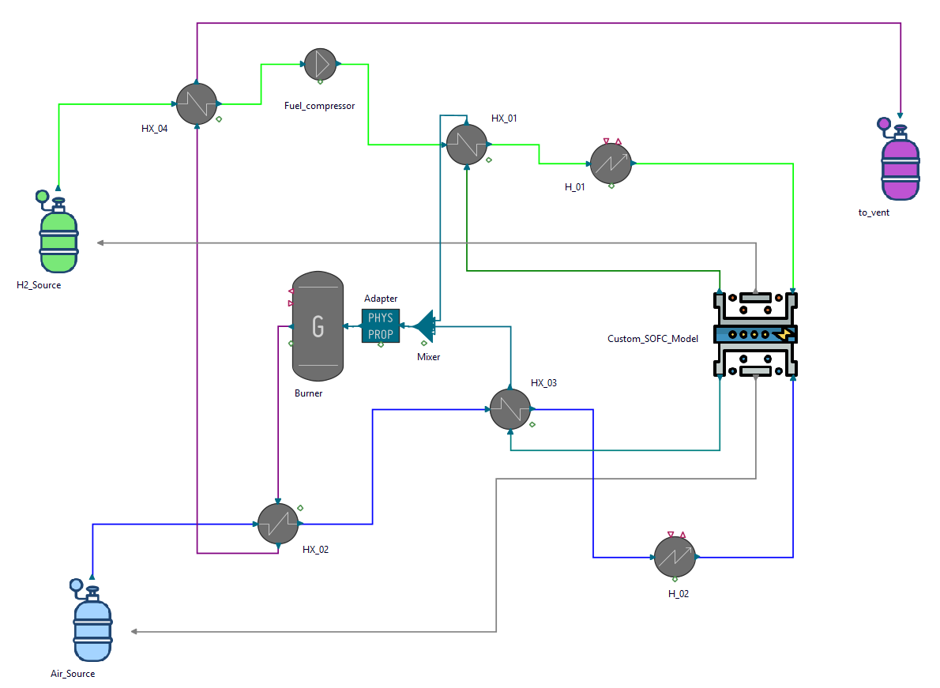
Figure 2 – Implementation of the hydrogen operating case in gPROMS Process
The collaboration with Siemens will therefore support the development of internal know-how and may open the way to future technical studies and white papers on topics such as hydrogen production routes, industrial process decarbonization and the use of digital process models to support investment and technology decisions.
Through this activity, FBK Sustainable Energy is expanding its modelling capabilities and strengthening the connection between applied research and industrial development.
Read more about the Center collaborations at this page: http://energy.fbk.eu/services/our-network-and-collaborations/